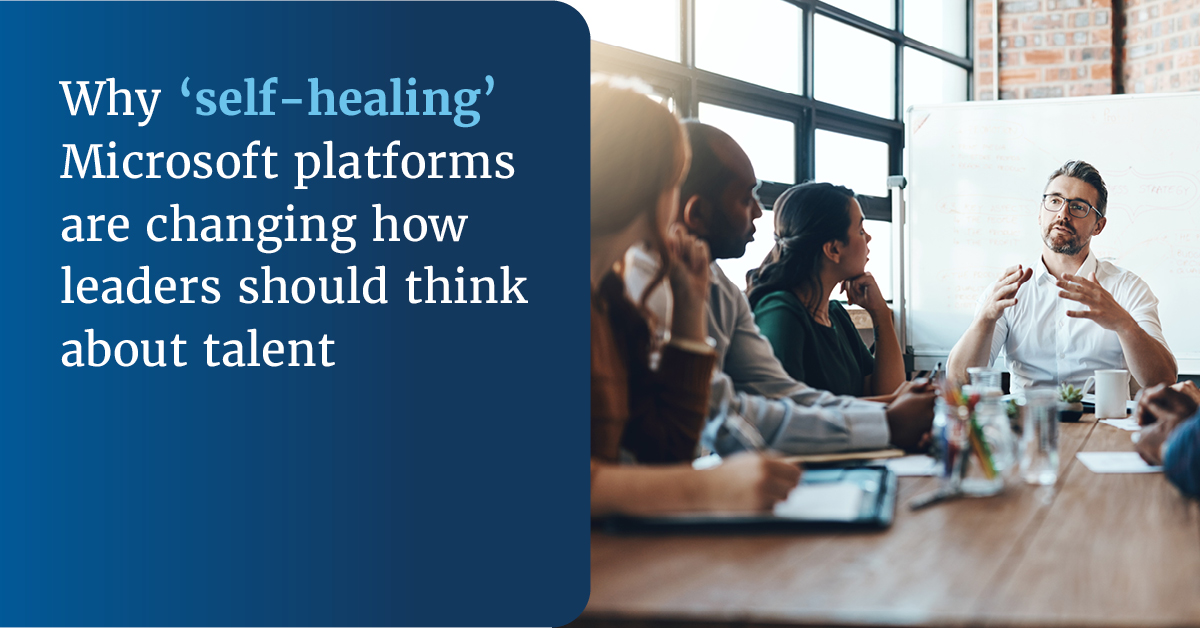
Microsoft Dynamics 365 and Power Platform are becoming more autonomous.
As organizations invest in Dataverse, Cloud Flows and AI-driven automation, a growing number of routine issues are no longer handled by people. They are handled by the platform itself.
Data sync failures can trigger automatic retries, workflows can detect and correct errors and processes can recover without human intervention.
For leadership teams, this raises a more fundamental question.
If the platform is fixing problems on its own, what should your team be doing instead?
The answer is reshaping how organizations approach Dynamics 365 and Power Platform delivery and more importantly, how they define the talent required to support it.
From reactive support to built-in resilience
Traditionally, Dynamics 365 and Power Platform environments required ongoing manual intervention.
When integrations failed or workflows broke, teams would step in to diagnose the issue, resolve it and restart the process. This created a model where delivery teams were structured around fixing problems after they occurred.
That model is becoming outdated.
Microsoft’s Dataverse and Power Platform now support more resilient architectures. Cloud Flows can be configured with retry logic, exception handling and automated escalation paths. Data platforms can monitor integrity and trigger corrective actions.
In simple terms, systems are becoming self-healing.
For organizations, this shifts the focus of delivery.
The priority is no longer how quickly issues can be fixed, it is how effectively they can be prevented, detected and resolved automatically.
Nigel Frank works with organizations to build Dynamics 365 and Power Platform teams that design resilient systems from the outset, reducing operational overhead and improving long-term performance.
The shift from ‘repair’ roles to ‘resilience’ design
This evolution is changing the type of expertise organizations need.
In the past, hiring often focused on developers or support professionals who could troubleshoot issues as they arose. These roles were essential in environments where manual intervention was the only option.
Today, that approach creates inefficiency.
Organizations that continue to rely on manual troubleshooting models often find themselves investing in roles that address symptoms rather than root causes. Over time, this leads to higher operational costs and slower delivery performance.
The emerging model prioritizes resilience over repair.
Leaders are increasingly looking for professionals who can design systems that minimize failure in the first place. This includes:
- Configuring automated retry and recovery logic within Power Platform workflows
- Designing Dataverse architectures that maintain data integrity across systems
- Embedding monitoring and alerting into platform operations
- Aligning automation with governance and compliance requirements
These capabilities are typically found in more advanced roles, such as Power Platform Architects or Platform Reliability Engineers.
For executives, the implication is clear.
The value of a Microsoft team is no longer defined by how well it responds to issues, it is defined by how effectively it prevents them.
Why misaligned hiring reduces platform ROI
As Dynamics 365 and Power Platform become more autonomous, a gap is emerging between how platforms operate and how teams are structured.
Organizations that continue to hire for traditional support models may find that their teams are focused on tasks that the platform is increasingly handling on its own.
This creates two challenges.
First, it limits return on investment. Resources are allocated to manual processes that could be automated, reducing overall efficiency.
Second, it slows progress toward more advanced capabilities. Time spent fixing issues manually is time not spent improving architecture, scaling automation or enhancing user experience.
In contrast, organizations that align hiring with platform capability are seeing different outcomes.
They build systems that are more stable, reduce operational overhead and create delivery environments that can scale without constant intervention.
According to the Nigel Frank Microsoft Careers and Hiring Guide, demand continues to rise for Microsoft professionals who combine technical expertise with architecture, governance and platform-level thinking.
This reflects a broader shift toward roles that focus on long-term performance rather than short-term fixes.
Self-Healing Systems Require a Different Leadership Approach
For C-suite leaders, the rise of self-healing platforms changes how success should be measured.
The question is no longer how quickly teams respond to issues, it is how rarely those issues occur and how effectively the system handles them without disruption.
This requires a shift in mindset.
Investment decisions should prioritize resilience, automation, and long-term stability. Delivery teams should be structured around architecture and reliability rather than reactive support. Performance metrics should reflect system uptime, adoption and business outcomes rather than activity levels.
Organizations that adopt this approach are moving toward a more scalable and predictable model of Microsoft platform delivery.
Those that do not risk maintaining delivery models that are increasingly out of step with the capabilities of the technology itself.
From Firefighting to System Design
Across Dynamics 365 and Power Platform environments, one theme is becoming clear.
The role of the team is changing:
- Where teams were once responsible for fixing problems, they are now responsible for designing systems that avoid them.
- Where delivery was once reactive, it is becoming proactive.
- Where success was once measured in effort, it is now measured in resilience.
For leadership teams, this represents an opportunity.
By aligning talent strategy with platform capability, organizations can reduce operational friction, improve delivery outcomes and maximize the value of their Microsoft investments.